


30 October, 2025
How to display small-format samples in a tile library

You have invested time, resources and passion in developing a new collection. The colours, finishes, textures… everything is designed to inspire. But when it comes to displaying it in the showroom, the format doesn’t look good, the space becomes cluttered and the collection loses its prominence. So, how to display small-format samples in a tile library to ensure each piece stands out?
And it’s frustrating. Because you know the material has potential, but it doesn’t come across the same on a panel or on any old shelf. Customers walk by, the pieces get mixed up and the brand message is diluted.
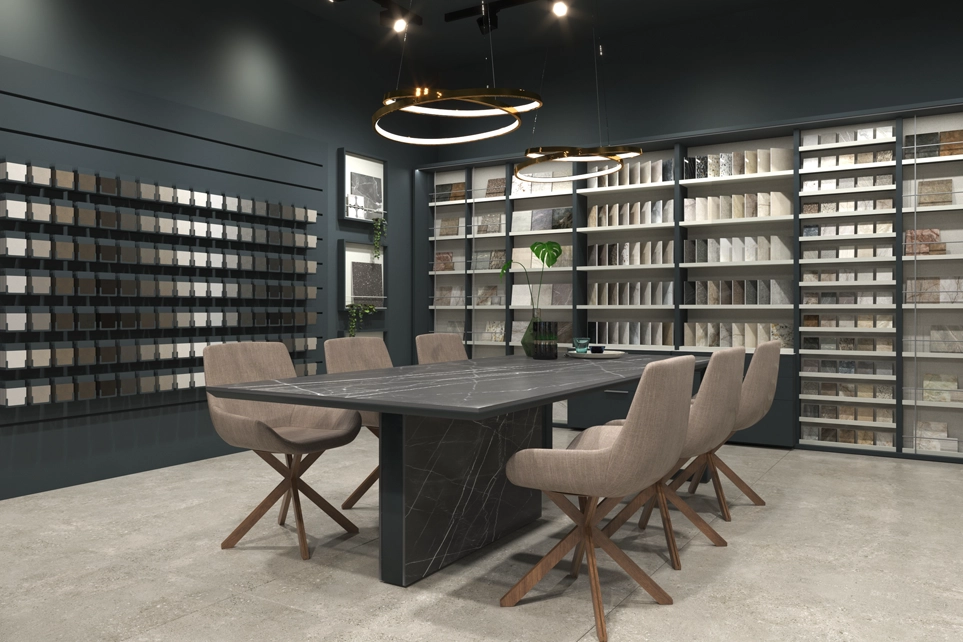
The reality is that displaying small formats well requires strategy: an exhibition design that combines inspiration, order and technology. When each sample finds its place, the tile library ceases to be a simple warehouse and becomes a piece of furniture for a tile shop that drives purchasing decisions.
In this article, we tell you how to display tiles to sell more, how to organise your space efficiently and which display solutions (such as the Boutique series or the I.RIS V03 system) are setting trends in building material showrooms.
How many samples should be included in a tile library or display panel?
This is one of the most common questions, and also one of the most difficult to answer. Because when a new collection arrives, we all want to see everything: every colour, every texture, every finish.
However, it is not the number of samples that determines the success of an exhibition, but how the space is organised so that each piece makes sense. Too much information is overwhelming; too much empty space is uninspiring.
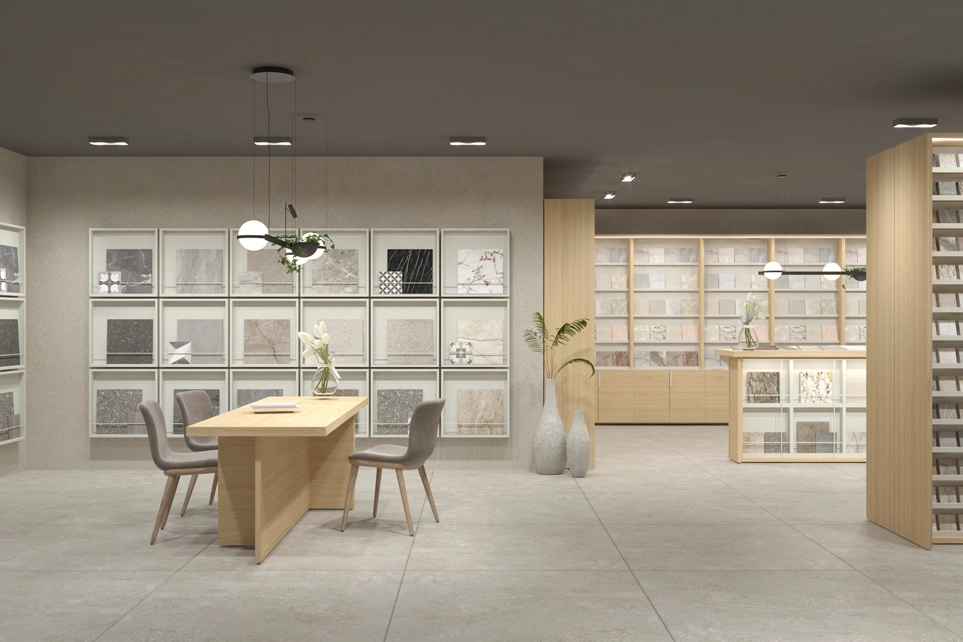
The balance lies in finding tile display systems that show the essentials and hide the rest without sacrificing the breadth of the catalogue.
You will be surprised to discover that a tile library can hold more than 100 references without looking cluttered, as long as there is a design that combines display and storage areas. This allows you to rotate collections, maintain order and renew the presentation without the need to expand the space.
And that is precisely what we have achieved with the Boutique Series: more than 25 tile display stands designed to create elegant, functional and fully customisable tile libraries. Its modular system allows you to combine different compositions according to the space, while the integrated lighting enhances the colour and texture of each piece.

It also incorporates workbenches and support areas that facilitate selection and the creation of compositions together with the customer. Everything is designed to make the showroom an orderly and inspiring environment.
How to improve the customer experience in small format displays
Displaying small formats well means creating a comfortable and clear selection experience. In other words, customers need to compare, touch, combine and visualise how the materials fit into their project, and the design of the space must facilitate this entire process.
That is why ceramic tile displays are evolving towards more functional solutions, where every detail is designed to improve interaction: ergonomic heights, smooth opening systems, accessible modules and integrated work areas.
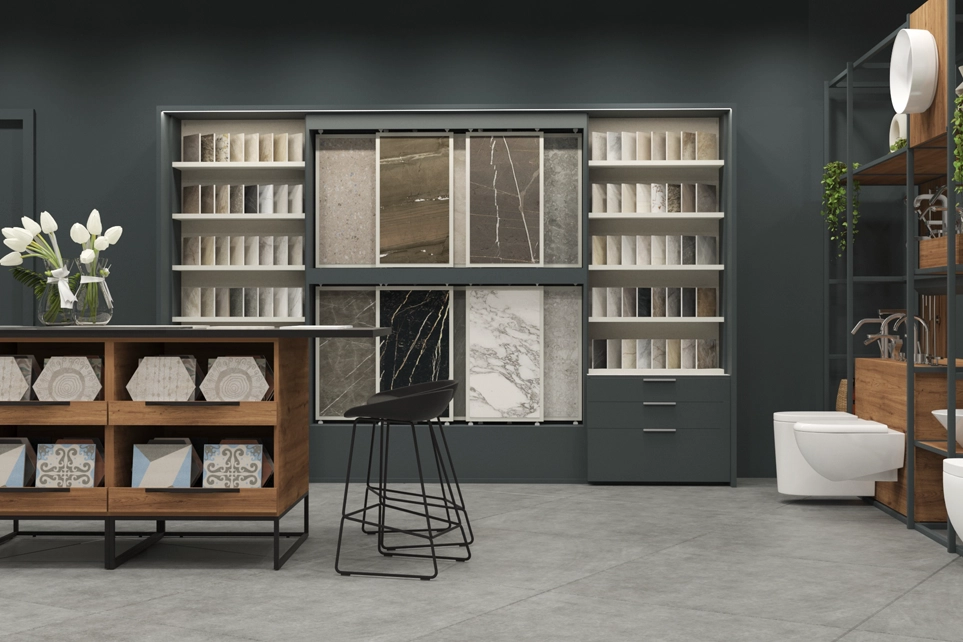
In line with this, the Boutique series offers an approach designed for the experience. For example, Composición 228 combines vertical sliding panels with storage areas at the bottom. In addition, its open structure makes it easier to view the product and helps to create a comfortable customer journey.
Next to it, the Boutique Table Balcony bench adds a practical dimension to the showroom: a display table designed as a workspace and source of inspiration. Here, customers and the sales team can arrange, display and create customised compositions.

Efficient organisation of small formats in showrooms
One of the biggest problems when displaying small formats is finding the balance between accessibility and order. When pieces are too visible, the space becomes chaotic; when they are too hidden, the customer loses interest. And it is on this fine line that the quality of an exhibition is defined.
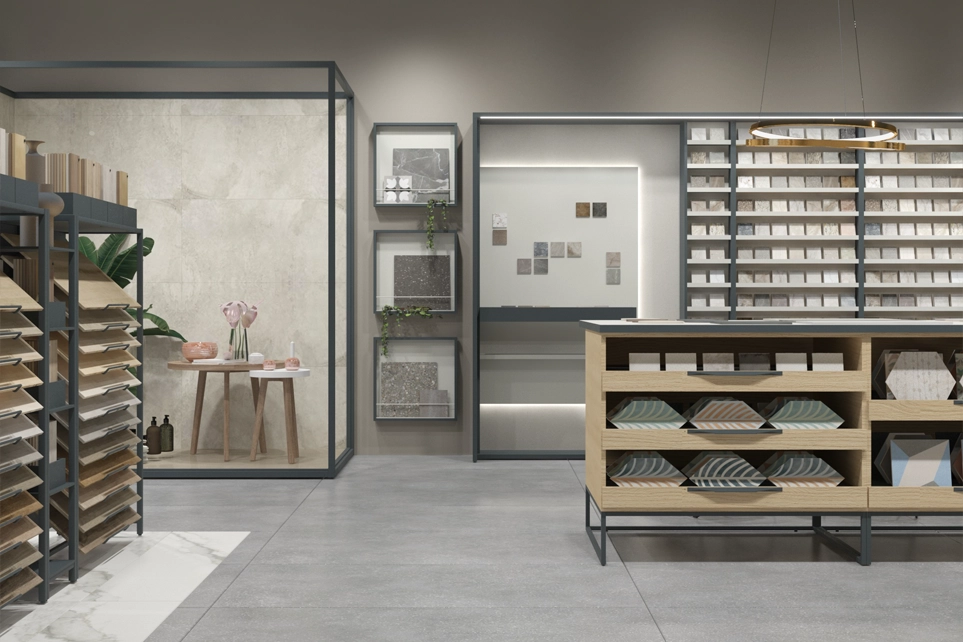
In this sense, a well-planned tile library should facilitate both the search for and handling of samples. Thus, each panel, shelf or workbench has a role to play in a strategy designed to reduce visual noise and enhance the shopping experience.
How to structure a tile library and how to display small-format samples?
The secret lies in designing a logical display flow that accompanies the customer in their decision-making process:
- Start the tour with the most commercial collections, those that generate immediate interest.
- Continue with the trend series or new products to maintain attention.
- End in a support or work area, where the customer can create combinations and make decisions.
This route therefore turns the showroom into a coherent narrative, where the customer can find their way around without needing constant help.
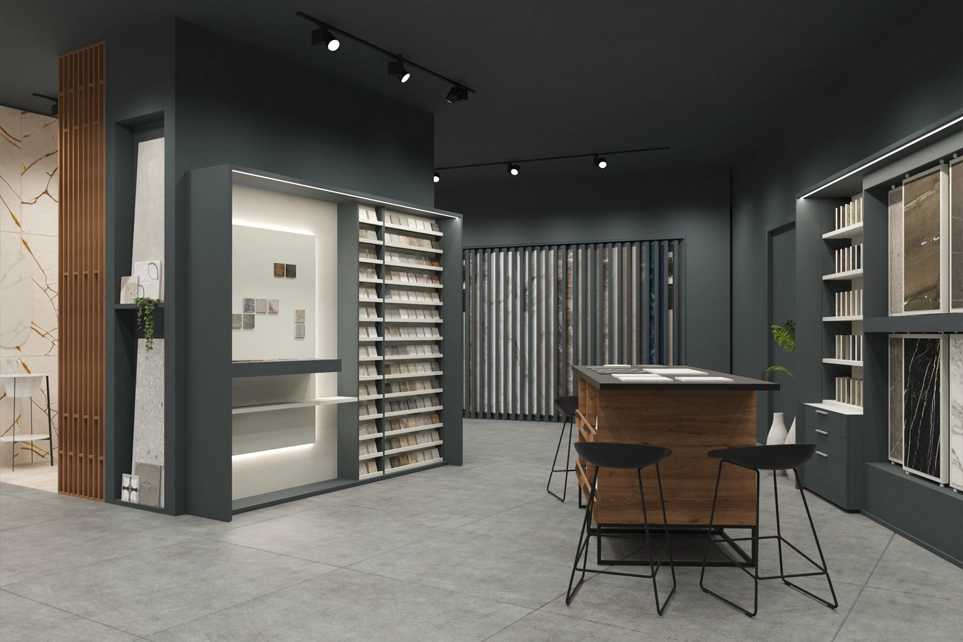
In turn, a good display system should facilitate the work of the sales team. When the material is well organised, the advisor can locate it quickly, present combinations and keep the display looking impeccable at all times.
In this case, for example, some modules in the Boutique series incorporate storage spaces, magnetic panels for mood boards, and backlit shelves that keep samples visible at all times without overloading the space. In addition, the possibility of incorporating version 03 of the I.RIS system allows for the digitalisation of room visualisations and technical information about the pieces.
Mood boards: inspiration in exhibition format
Pieces measuring 10×10 cm or 20×20 cm rarely convey the power of a complete collection on their own. That is why a growing trend in showroom tiles design is the incorporation of mood boards. These panels allow you to create compositions with different materials and finishes, helping customers to visualise real combinations.
In turn, this approach also facilitates the work of the sales team, which moves from ‘showing’ products to co-creating projects with the customer.
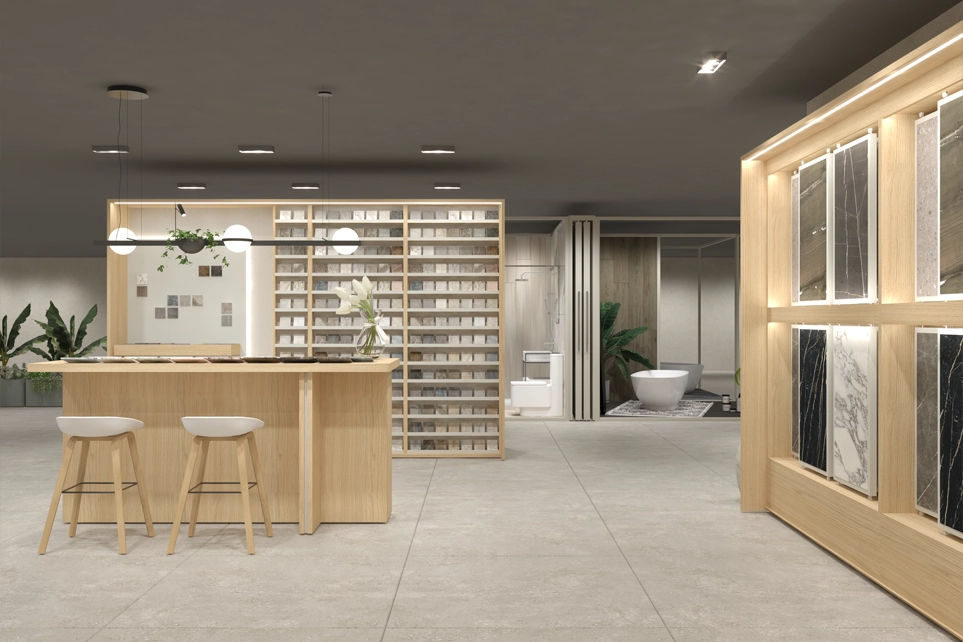
This way of working finds its best expression in the Boutique series. The Boutique Workbench module, for example, incorporates a magnetic panel that allows mood boards to be created directly in the exhibition space, combining pieces, finishes and textures in real time.
In this way, professionals can show customers how the materials interact with each other, explore different compositions and visualise the final result before making a decision.
Digitalisation and consistency in product representation
Although digital tools facilitate product consultation, nothing replaces the experience of touching ceramics, appreciating their texture or seeing how they reflect light.
That is why version 03 of the I.RIS system can also be integrated into the Boutique series tile sample board display. This system incorporates a mobile scanner capable of reading labels on small-format pieces (from 30 × 30 cm), linking them to their digital information: technical data sheets, finishes, settings, or colour variants. Everything is available instantly, without leaving the display area.
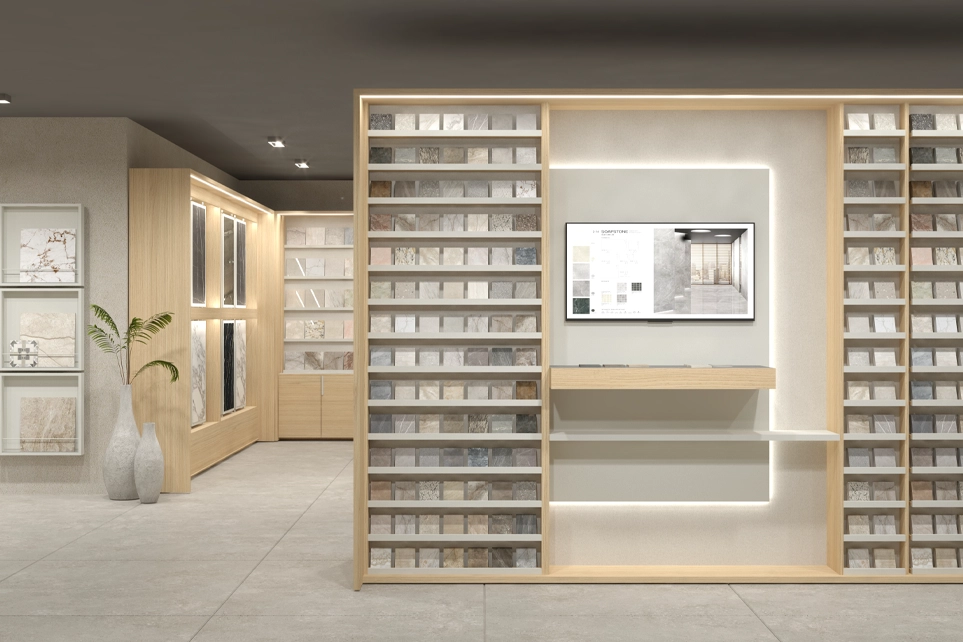
This allows customers to consult real data while touching the material, and the sales team gains agility and confidence when presenting the product.
In conclusion, displaying small formats correctly is an opportunity to differentiate your brand and connect better with customers. When the space is designed to guide the customer, when each module has a clear function and every detail facilitates choice, the display becomes a natural extension of the brand.
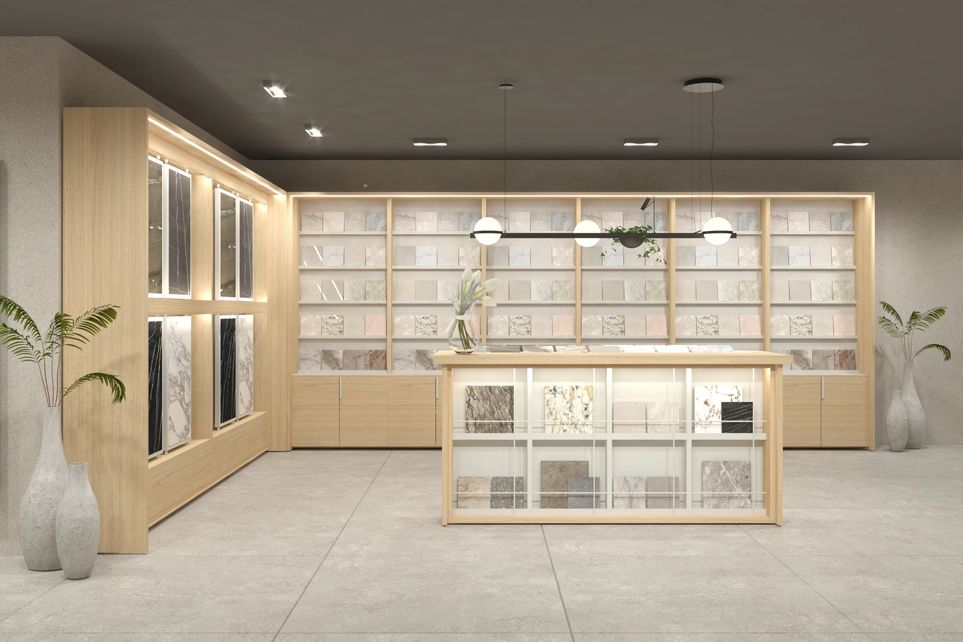
Tile libraries, especially those equipped with solutions such as the Boutique series and the I.RIS V03 system, set a new standard in the sector: environments where technology, design and commercial strategy work together to inspire.
At INSCA, we have been developing tiles display racks and tile displays for showrooms for almost 50 years, helping our customers to sell more and showcase their products better.
If you are thinking of renovating your display or creating a specific area for small formats, our team can help you find the most suitable solution.
Lorena Rodriguez

Offices and factory
Polígono industrial Vía Europa II,
calle Benlloch, 12550
Almazora / Castellón (Spain)
Phone: +34 964 043 004
Whatsapp: +34 658 504 151
Email: info@insca.com
Logistics hub
Camino Alcora, 34 12550
Almazora / Castellón (Spain)
Phone: +34 964 043 004
Whatsapp: +34 658 504 151
Email: info@insca.com


